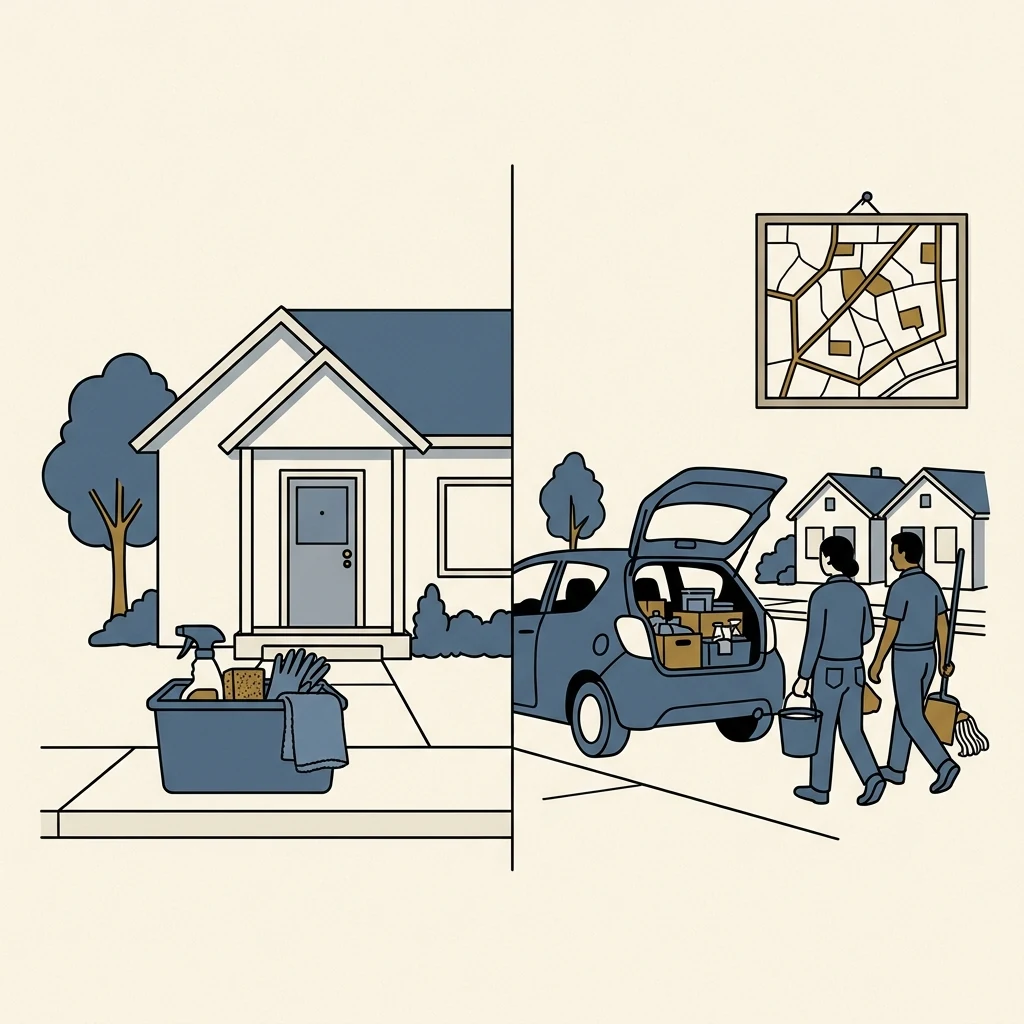
A residential cleaning franchise is not a way to clean houses for yourself. Molly Maid, Merry Maids and The Maids all sell the same thing: a territory, a brand and a system for running a crew of employees who do the cleaning while you manage them. That business costs $117,000 to $197,000 to open and about 8.5% of every dollar it brings in after that. If what you actually want is to clean homes yourself, maybe on evenings and weekends while you keep your day job, the franchise is the wrong tool, and the real choice is not "franchise or not." It is "solo cleaner or crew company."
The question comes up constantly on cleaning-business forums, usually from someone with a steady job, a budget of $25,000 to $50,000, and a hope that a franchise will hand them their first clients. Here is how to answer it from the franchise disclosure documents instead of the sales call.
Two businesses that share a name
A solo house cleaner and a maid franchise are different businesses with different economics. The solo cleaner sells their own hours. Startup costs are small: NEXT Insurance puts many residential cleaning startups at $500 to $3,000 (NEXT Insurance), and Insureon's median policy data shows a house cleaning company paying about $608 a year for general liability and $112 a year for a janitorial bond (Insureon). Income is capped by how many homes one person can clean in a week, but almost everything a client pays stays with the cleaner.
The franchises are built on the other model. Molly Maid's own recruiting FAQ answers "How involved will I be in the day-to-day services?" with: "You'll be managing the business, not performing the cleaning." It also says training "on the trade itself is not provided" (Molly Maid franchise site). Merry Maids and The Maids run on the same idea: the owner hires, schedules, sells and handles complaints, and teams of employees do the work.
So if you are asking whether to buy a cleaning franchise or start your own because you want to clean, the franchisor has already answered for you. They are not selling that job.
What the money buys
All three brands cost about the same to open, and none of them is cheap to run. The figures below come from the brands' most recent FDDs as summarized by FDD research services and compiled in our franchise directory.
| Brand (FDD year) | Up-front fee | Total to open (Item 7) | Royalty + ad fund at entry level | What Item 19 actually reports |
|---|---|---|---|---|
| Molly Maid (2025) | $14,900 + territory fee of about $45,000–$70,000 | $139,900 – $197,200 | 6.5% + 2% = 8.5% | $173.43 average per cleaning; $16.23 average per target household. No total sales per business. |
| Merry Maids (2025) | $55,000 | $126,880 – $165,610 | 7% + 1.3% = 8.3% | $487,441 average gross sales for the 306 territories of the type sold today (median $427,425). All 725 active franchises: median $262,519. |
| The Maids (2026) | $60,000 for one territory | $117,720 – $141,200 | 6.9% + 2% = 8.9% | $1,184,666 average per owner, but owners hold about 3.2 territories each. Per territory works out to roughly $371,000 (our division). |
The royalty rates fall as sales grow at all three brands, so 8.3% to 8.9% is what a new owner pays, not what a large one pays. They also have floors. Molly Maid charges minimum license fees and sets a local marketing requirement of $1 per target household per year that declines as sales rise (FranchiseChatter's review of the 2025 Molly Maid FDD). On a territory of 50,000 households, that is up to $50,000 of required local marketing in a year, on top of the 2% fund. None of the three discloses costs or profit, only sales.
The fee is up front, the value fades, the royalty doesn't
This is the argument that should decide it for anyone who could run a crew either way. What a maid franchise mostly sells is speed of getting customers: a brand people recognize, a booking system, national advertising and a playbook for hiring. That help is worth the most in years one and two, while you have no clients. Cleaning is a repeat business, and Molly Maid's own Item 19 says 91% of its cleanings came from recurring customers. Once the book is built, the brand does much less work for you each year.
The royalty does not shrink to match. It is a share of gross sales for the life of the agreement, and Molly Maid's runs ten years. At the Merry Maids median for current-format territories, $427,425, the 8.3% comes to about $35,500 a year. At The Maids' rough per-territory figure, the entry rate on $371,000 is about $33,000. At Molly Maid's average ticket of $173.43, 8.5% is about $14.75 of every cleaning, before the local marketing requirement.
So the test is not "is the brand worth something." It is: after year two, will the brand still bring in more than about $30,000 to $35,000 a year of business you could not get with that same money spent on your own ads, reviews and referral offers? For a manager with no local reputation, maybe. For someone who already has a list of clients, almost never.
The costs you pay either way
Some of what looks like the franchise's price is really the price of having employees. Once you hire cleaners, you carry payroll taxes, and workers' compensation insurance is required for employers in most states (Texas is the best-known exception; check your state's rules on Insureon's state-by-state guide). Insureon's median for a cleaning business is about $1,364 a year for workers' comp. You also need vehicles, supplies for each team, scheduling software and someone answering the phone.
An independent owner who grows into a crew company pays all of that too. The fair comparison is therefore your own crew company against a franchised crew company, and the difference between them is the up-front fee, the build-out in Item 7 and the 8% to 9% of sales. Our affordability calculator shows what is left after those fees at a revenue level you choose. Leave your own salary out of the result and add it back in at the end.
Read the headline number carefully
Each of these brands has a headline revenue figure that overstates what one new territory earns. Merry Maids' $487,441 average covers only the 306 newer-format territories, while more than half of its 725 active franchises are older, smaller territories that are no longer sold. The Maids' $1.18 million is per owner, and the typical owner in that group holds about three territories; fewer than a third of owners reached the average. Molly Maid does not give a business total at all, so you have to multiply its per-household figure by your territory's household count, and that figure ranges from $2.59 to $88.13 per household.
If a salesperson quotes you a number that is not in Item 19, ask where it came from. Our guide to reading a franchise disclosure document covers which items to read first.
How residential differs from commercial cleaning franchises
Residential and commercial cleaning franchises are often lumped together, and they work almost oppositely. In commercial janitorial franchises like Jan-Pro, Jani-King and Coverall, a small buyer pays for a package of office-cleaning accounts and usually cleans them personally, at a cost that can start in the low thousands. In residential maid franchises, you pay six figures for a territory and a system and are expected not to clean. The commercial model is the one that looks like "buy a franchise and clean," and it has its own problems with who controls the accounts.
Who each option fits
- You want to clean homes yourself and keep your job for now. Start independently. Spend a few thousand dollars on supplies, insurance, a bond and simple marketing, and build a client list on weekends. No maid franchise is designed for you.
- You have cleaned for years and already have clients. A franchise would charge you about 8% to 9% forever for customers you mostly already have. Grow into crews on your own.
- You are a manager with $150,000 or more to invest, no cleaning background, and you want to run a staff of 10 to 30. This is the buyer the franchise is built for. The fee buys a way to get customers and a hiring playbook you would otherwise build slowly. Read our piece on semi-absentee franchises before assuming you can do it part-time: managing crews is a full-time job until you have a manager, and a manager's salary comes out of the same profit.
Before you sign anything
Ask the franchisor for the Item 19 figures for your territory format only, not the system average. Multiply the royalty and ad fund by the year-three sales you are planning for, and decide whether you would pay that amount for marketing every year for a decade. Read the minimums in Item 6. Then call former franchisees from the Item 20 list, not only the current ones the sales team suggests, and ask how much of their business came from the brand after the second year.
If the honest answer is "very little," you are paying for a head start. That can be worth it, but only if you plan to run a crew, never if you planned to hold the mop yourself.
Figures are from the 2025–2026 FDDs as summarized by FDD research services and may change with the next filing. Read the current FDD and consult a franchise attorney before signing. The Franchise Dossier is not affiliated with Molly Maid, Merry Maids or The Maids.